
New book · Published November 2026 (Korean)
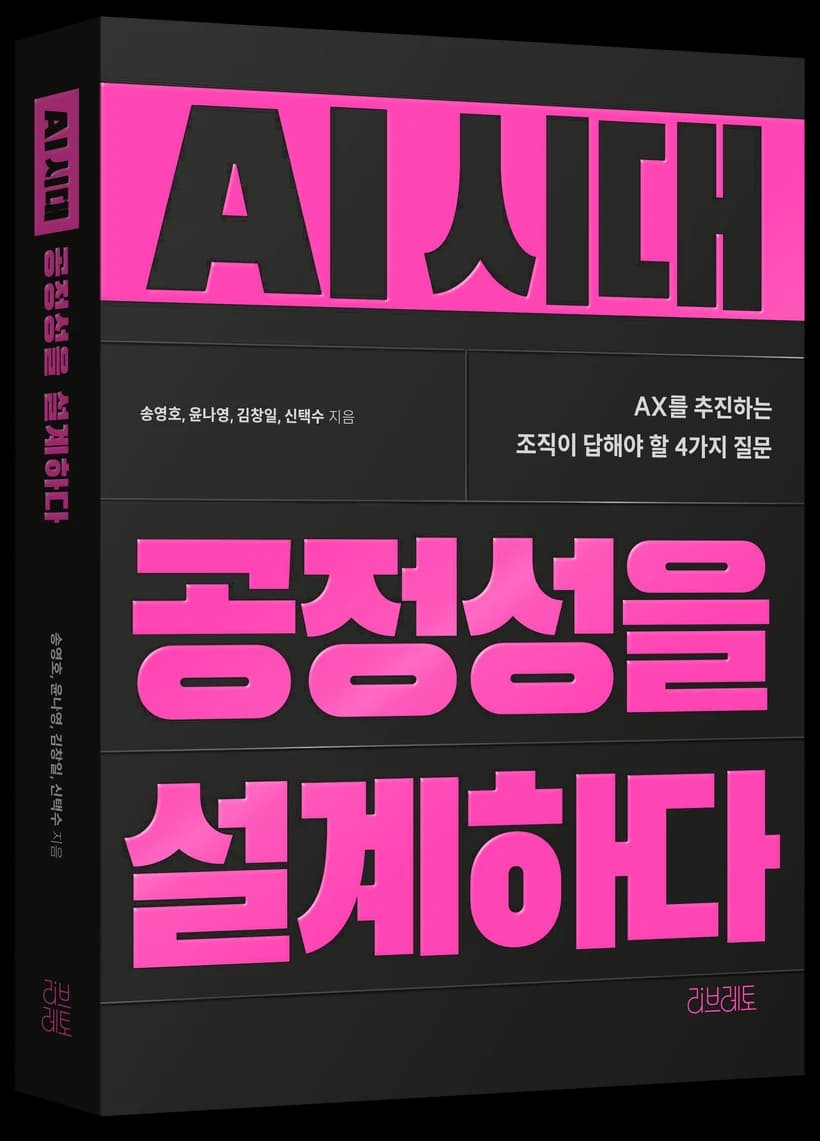
Designing Fairness in the Age of AI
Four questions every organization driving AI transformation must answer
Youngho Song, Natalie Yun, Changil Kim, Taegsu Shin · Libretto · Published in Korean as 『AI 시대 공정성을 설계하다』 (English title is our translation)
Can you explain an AI-made decision to the people it affects?
When AI evaluates people and divides rewards, the standards employees can accept still have to be designed by people. This book goes past asking whether AI is fair, to how fairness is actually designed.
Why now
“I can accept the result. What I can't understand is how it was decided.”
From the introduction (translated from Korean)
Those were the words of a fifth-year employee in an exit interview. They never mentioned pay or workload. What they could not accept was that no one could explain why they were passed over.
Read more
Year-end reviews now note that “AI analysis was considered,” and applicants must clear an algorithm before they meet a person. The more decisions shift toward AI, the heavier the duty to answer that question.
Decide in advance what data will be used to evaluate people, explain those standards in words people understand, and leave a channel to ask and a person to take a second look. Built after something goes wrong, these become excuses. Built in advance, they become trust.
Four questions
Four questions for any organization driving AI transformation
People don't judge fairness by the size of the reward alone. They weigh the process, whether they were treated with respect, and whether they were told why. Tap a question to see that part's chapters.
1PART 1 · Distributive fairnessIs my share fair?AI grows output and blurs whose output it is. Who should gain from the extra results and the time saved?
In this part
- 1-1.What is a fair distribution?
- 1-2.What AI changes about distribution
- 1-3.New unfairness created by AI
- 1-4.Cracks in distribution: whose side will AI take?
- 1-5.Designing fairness
2PART 2 · Procedural fairnessAre the process and the criteria fair?If you can't explain it, you can't be accountable for it. The conditions a process must meet when AI enters hiring, reviews, and promotion.
In this part
- 2-1.Trust in the process, not just the outcome
- 2-2.Can AI explain a hiring decision?
- 2-3.Transparency in reviews, training, and promotion
- 2-4.Why decisions go wrong
- 2-5.Discrimination, surveillance, privacy, and fair procedure
3PART 3 · Interpersonal fairnessAm I treated with respect?Feeling treated fairly comes less from accuracy than from feeling understood. What respect means when systems deal with people.
In this part
- 3-1.What it means to be respected
- 3-2.People, AI, and systems: rewiring communication
- 3-3.Who holds the power in hiring?
- 3-4.Data-driven leadership: does respect grow?
- 3-5.Designing respect
4PART 4 · Informational fairnessAm I told why?Information asymmetry in the AI era is a question of power. From hidden proxy variables to AI governance, the channels for explanation and appeal.
In this part
- 4-1.Information asymmetry as power
- 4-2.The promise and shadow of AI hiring experiments
- 4-3.The trap of hidden proxy variables
- 4-4.Redistributing opportunity: mirror or scale?
- 4-5.AI governance: making informational fairness institutional
Two seats
The same word, fairness, asks different things depending on where you sit
HUMAN-IN-THE-LOOP
Inside the loop
“Am I being treated fairly?”
Employees working alongside AI
HUMAN-ON-THE-LOOP
Over the loop
“Did I build a fair system?”
Leaders and HR who design and oversee it
Authors
Four authors who have worked on fairness from different seats
Academia, global companies, the public sector, and large Korean enterprises. Four people from research and HR practice wrote it together.

Youngho Song
Professor, Odette School of Business, University of Windsor
View bio
- · Adjunct Professor, aSSIST University (Seoul)
- · Editorial board, Human Relations and Journal of Vocational Behavior
- · PhD in Management, McGill University; MS in Industrial and Labor Relations, Cornell University
Researches organizational justice, emotional labor, and how AI use changes employee performance and behavior, with work published in journals including the Journal of Management and the Journal of Applied Psychology.

Natalie Yun
CEO & Principal Consultant, OptiMax Partners Inc.
View bio
- · SHRM-SCP, MBA, CBC, BBCC
- · MBA, Odette School of Business, University of Windsor
- · Enterprise Risk Management Board member, Windsor Regional Hospital
Led talent development, organizational change, and leadership for 25+ years at Fortune 500 companies including Bristol-Myers Squibb, Dell Technologies, and AMD. Now based in Canada, Natalie helps Korean companies settle in North America through people, organization, and talent strategy, and coaches teams and leaders with behavioral and brain-based methods.
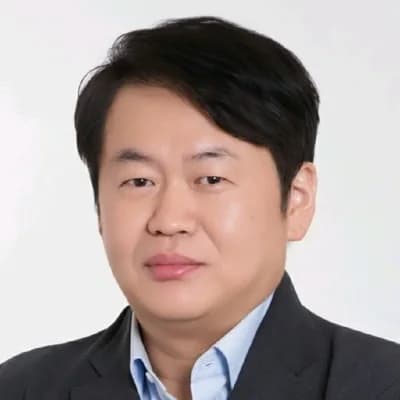
Changil Kim
15 years in HR at the Academy of Korean Studies; public-sector AI transformation practitioner
View bio
- · PhD in Policy (AI public policy), Seoul National University of Science and Technology
- · Author of three books on ChatGPT, AI and HR, and AI and jobs
Draws on years of running hiring, promotion, and review systems to study organizational justice and AI-based HR innovation. Builds HR tools, shares them on GitHub, and teaches AI and HR to companies and public agencies.

Taegsu Shin
HR practitioner at Hyundai Motor Group, SK Group, and KT Group
View bio
- · MA in Labor Economics, Korea University
- · Adviser on national talent policy
- · Lecturer on hiring strategy in MBA programs
Has led performance management, talent acquisition, and HR broadly, connecting research and practice on industry change and future talent strategy in the AI era.
Endorsements
What early readers say
“When AI evaluates people and allocates results, whom do we appeal to, and how do we trace the algorithm? (…) Not every answer, but a clear sense of direction.”
“Will employees feel a data-driven decision is fair? The book maps that gap through four kinds of fairness: distributive, procedural, interpersonal, and informational.”
More endorsements
“Four authors offer practical and theoretical guidance on how leadership, systems, and governance must change to keep respect for people at the center.”
“The authors' message, that people's voice and accountability must remain even when we use AI, will be a clear guide for leaders and HR practitioners.”
“Reading the thinking of four people who moved between research and HR practice, I reflected on what not to miss when adopting AI.”
Endorsements translated from Korean by OptiMax Partners Inc.
A 30-minute check for Korean companies in North America
Hiring in North America? Design your people practices from day one.
Hiring, review, and termination rules in Canada and the U.S. often differ from head office. Fixed after a problem, they become a cost. Built in advance, they become trust. We'll use the book's four questions to review where your company stands.
Book a free 30-minute HR checkKorean and English · SHRM-SCP · OptiMax Partners Inc.